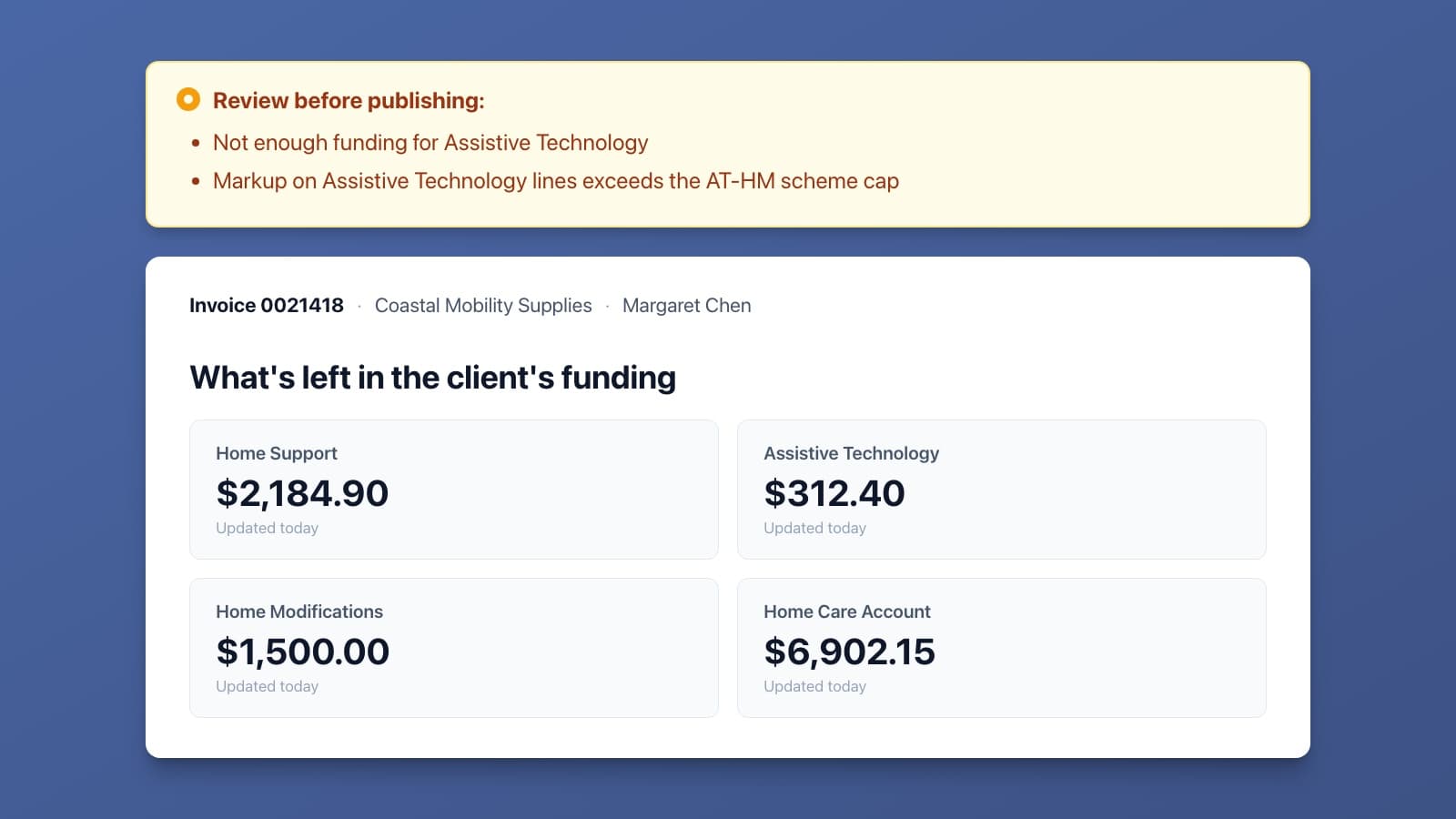
Every client-billable invoice now gets two extra checks before you approve it. Does the client have enough funding to cover it? And on Assistive Technology and Home Modifications lines, is the markup inside the cap? If either check fails, a warning shows at the top of the invoice.
Is there enough funding?
A Support at Home client does not have one budget. They have a quarterly Home Support budget, separate allocations for Assistive Technology and Home Modifications, and sometimes a Home Care Account holding unspent Home Care Package funds. An invoice can look fine against the total and still overdraw one of them.
Invoice Harbour checks each invoice against the client's projected balance in every pool it draws on. If a balance cannot cover the invoice, you see Not enough funding for Home Support (or Assistive Technology, or Home Modifications).
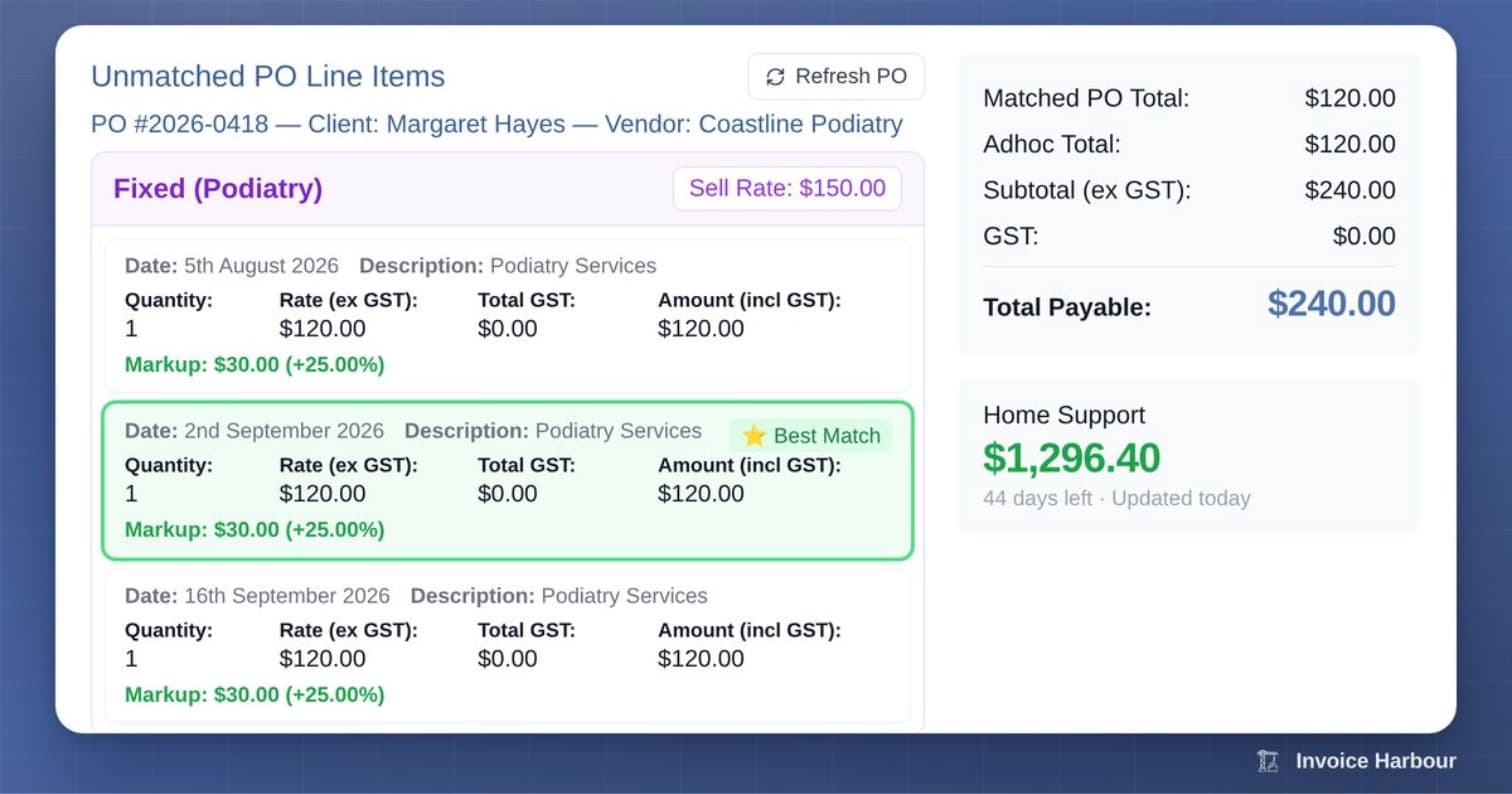
Money already committed under a purchase order is not counted again. If an invoice line matches a purchase order line, only the amount over the order counts as new spend. An invoice that matches its purchase order exactly will not trigger a warning.
Is the AT-HM markup inside the cap?
The AT-HM Scheme limits how much a provider can add on top of the supplier's cost. For Assistive Technology the cap is 10% or $500, whichever is lower. For Home Modifications it is 15% or $1,500, whichever is lower.
Invoice Harbour compares the markup on the invoice against that cap. The check is per invoice, not per line, so an item the supplier has split across several lines is treated as one item. If the markup is over, you see Markup on Assistive Technology lines exceeds the AT-HM scheme cap (or Home Modifications).
A warning, not a block
Neither check stops you publishing. You might know a top-up is on the way, or that the markup figure is a quoting quirk. The warning is there so you see the problem before the invoice goes to your finance system and care platform, not on next month's statement.
Nothing to set up
The checks run on their own. The funding check waits until the client's balances have loaded from the care platform, so a warning is never based on half the picture.
If there are other checks you would find useful at approval time, tell us.